Loading
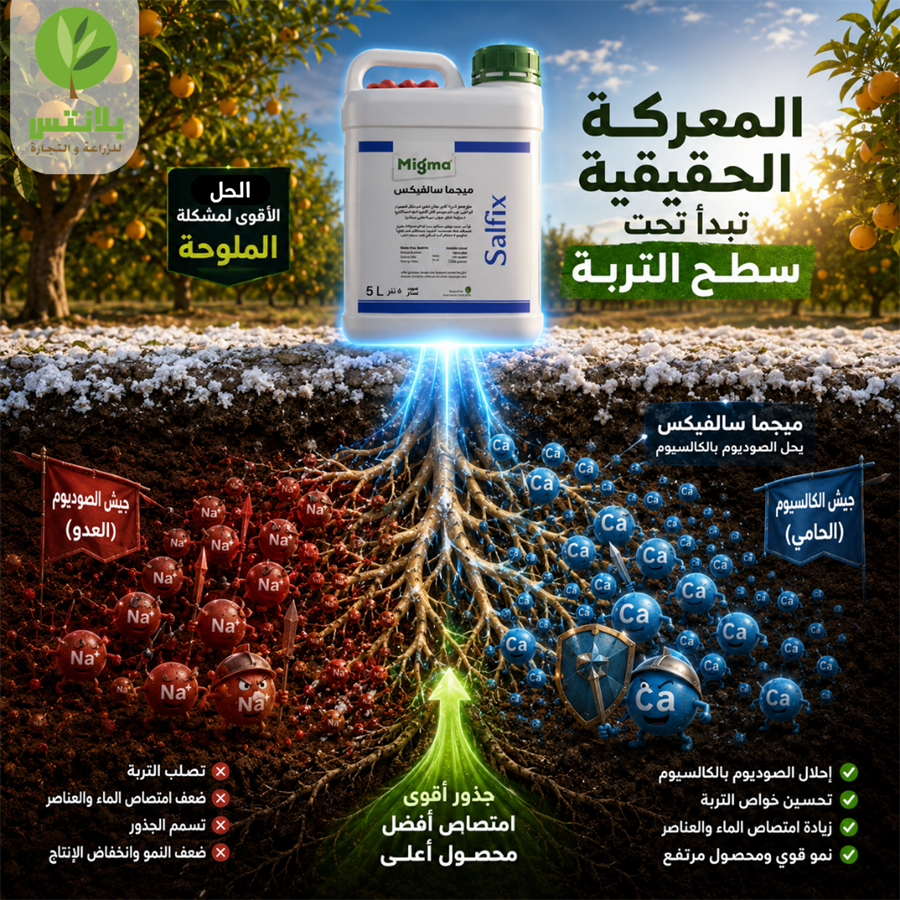
Treating Soil Salinity in Citrus Orchards: How to Maintain Strong Roots and Increase Tree Productivity
Soil salinity is one of the most common challenges affecting the growth and productivity of citrus trees, especially in soils with high sodium levels or when irrigation water has elevated salinity.
Many growers assume the problem lies in the fertilization program, while the real issue is often the soil itself. Excess salts reduce the roots' ability to absorb water and nutrients, even when high-quality fertilizers are applied.
Soil salinity occurs when salts, particularly sodium, accumulate around the root zone. This negatively affects the soil structure, making it more compact and reducing its ability to retain water and air.
As the problem persists, nutrient uptake declines, resulting in weaker tree growth and reduced productivity.
If you notice any of the following symptoms, soil salinity may be the cause:
✅ Poor tree growth.
✅ Yellowing leaves and reduced plant vigor.
✅ Leaf tip and edge burn.
✅ Weak root development.
✅ Reduced nutrient uptake.
✅ Smaller fruit size and lower yields.
✅ Poor fruit set and increased fruit drop.
Roots are responsible for absorbing water and essential nutrients.
When sodium levels become excessive:
🔹 Water absorption decreases.
🔹 Uptake of both macro and micronutrients is reduced.
🔹 Soil becomes compacted and less porous.
🔹 New root growth is restricted.
🔹 Trees become more vulnerable to environmental stress.
For this reason, improving soil conditions is just as important as following a proper fertilization program.
At the beginning of the fruit sizing stage, citrus trees require significantly more water and nutrients to support fruit enlargement and improve fruit quality.
During this period, healthy and efficient roots are essential to maximize the benefit of every irrigation and fertilizer application.
However, when soil salinity is high, sodium accumulates around the roots, reducing their ability to absorb water and nutrients. This directly affects fruit size, fruit quality, and overall yield.
Therefore, managing soil salinity during the fruit sizing stage is essential to ensure efficient water and nutrient uptake and to maximize the effectiveness of fertilization programs.
Effective salinity management focuses on reducing the harmful effects of sodium while improving soil structure to restore healthy root activity.
Key management practices include:
✔ Improving soil drainage.
✔ Using the best available irrigation water quality.
✔ Conducting regular soil analysis.
✔ Applying products that replace sodium with calcium and improve soil structure.
Megma Salvix is an effective solution for improving soil conditions and reducing the negative effects of excess sodium. It helps to:
✅ Replace sodium with calcium, improving soil structure.
✅ Enhance soil aeration and reduce compaction.
✅ Increase water and nutrient uptake efficiency.
✅ Promote stronger and more extensive root development.
✅ Help trees better tolerate salinity stress.
With healthier root conditions, citrus trees can make better use of fertilization programs, particularly during the fruit sizing stage, leading to improved growth, larger fruits, higher fruit quality, and increased productivity.
It is recommended for soils suffering from:
✔ High sodium levels.
✔ Soil salinity.
✔ Weak root growth.
✔ Poor nutrient uptake.
✔ Soil compaction.
For best results, Megma Salvix should be incorporated into the soil management program throughout the growing season, especially before and during the fruit sizing stage.
Successful citrus production starts with healthy soil and strong roots.
As fruit sizing begins, root efficiency becomes the key to maximizing water and nutrient absorption, directly influencing fruit size, quality, and final yield.
Managing soil salinity is not simply about improving soil properties—it is a strategic investment in better nutrient uptake, healthier trees, and higher productivity.
If your citrus orchard is affected by soil salinity, choosing effective solutions such as Megma Salvix can help restore soil vitality, improve root performance, and maximize the efficiency of your fertilization program throughout the season.