Loading
Many farmers are looking for the best way to nourish plants and achieve higher productivity. This raises a common question: Is foliar application better, or is fertilization through irrigation more effective?
Foliar application does not replace soil fertilization. In this article, we explain the difference between the two methods, their advantages and disadvantages, and when to use each one to achieve the best results for crops.
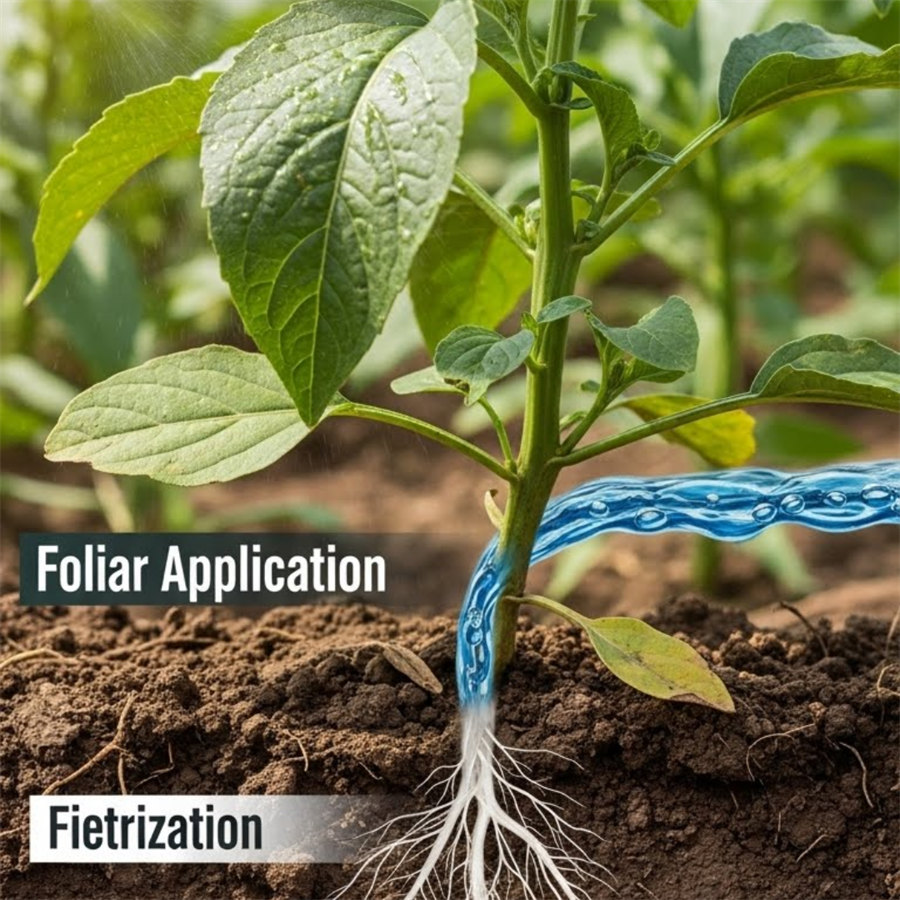
Foliar application is a fertilization method that involves spraying nutrients directly onto plant leaves, where they are quickly absorbed through the leaf stomata.
Foliar application is known for its rapid results, making it an ideal solution for correcting nutrient deficiencies, especially micronutrients such as iron, zinc, and manganese. It is also highly effective during critical growth stages such as flowering and fruit set, particularly when supplying nutrients like calcium, boron, and phosphorus. In addition, it helps plants overcome periods of stress.
Despite its fast action, foliar application has a short-term effect and cannot be relied upon as a primary source of nutrition. Incorrect concentrations may also cause leaf burn and plant damage.
Fertigation is the process of adding fertilizers to irrigation water so that nutrients are delivered directly to the root zone. It is the main method of providing long-term plant nutrition.
Fertigation helps build a strong root system and supplies plants with essential macronutrients such as nitrogen, phosphorus, and potassium on a regular basis. It is well suited for continuous nutrition programs aimed at improving plant growth and yield.
The effects of fertigation appear more slowly compared to foliar application. Nutrient uptake efficiency can also be influenced by soil type and salinity, and some nutrients may be lost through leaching or fixation in the soil.
The main difference between foliar application and fertigation lies in the method of nutrient absorption and the speed of response.
Foliar application provides fast and direct nutrition, while fertigation offers gradual and sustainable feeding through the root system.
Foliar application is recommended when nutrient deficiency symptoms appear, during flowering and fruit set stages, and under conditions of heat stress or poor root nutrient uptake.
Fertigation is preferred during vegetative growth stages and plant establishment, and for providing balanced nutrition throughout the growing season—especially in systems that rely on regular fertilization programs.
Relying on a single method is not ideal. The most effective fertilization program combines both foliar application and fertigation.
Fertigation serves as the foundation of plant nutrition, while foliar application acts as a fast-support tool to correct deficiencies and stimulate plants during sensitive stages.
Choosing between foliar application and fertigation does not depend on absolute superiority, but rather on plant needs and growth stage. A smart combination of both methods is the optimal approach to achieving healthy plants and high-quality yields.